



Residency in Panama under Friendly Nations visa in 2026
01/05/2026
Idiosincrasia di Panama: curiosità e segreti sorprendenti
25/05/2026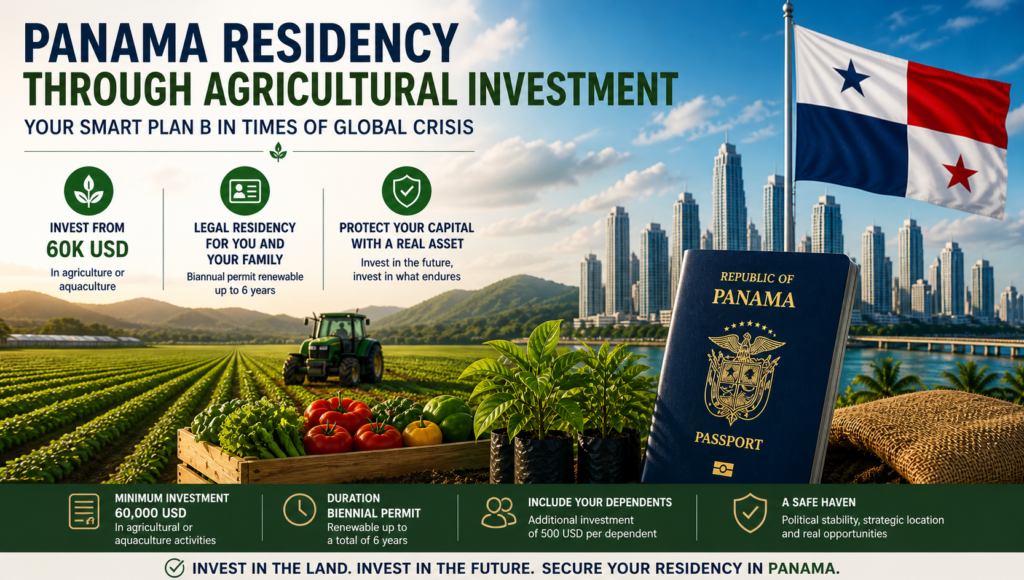
In the global crisis, create your Plan B with residency in Panama through agricultural investment. Invest $60K, obtain residency and protect your capital
Residency in Panama through agricultural investment has become one of the most interesting alternatives for those who seek to establish themselves in the country while developing a tangible economic activity. Unlike other migration programs focused on passive investments, this model requires direct participation in the productive sector, which creates a real connection between the investor, the land, and the local economy.
This approach is not accidental. Panama has begun to orient its migration policy toward strategic sectors, and agriculture is one of them. Residency in Panama through agricultural investment not only facilitates legal entry into the country, but also promotes rural development, encourages national production, and strengthens food security in an increasingly complex global context.
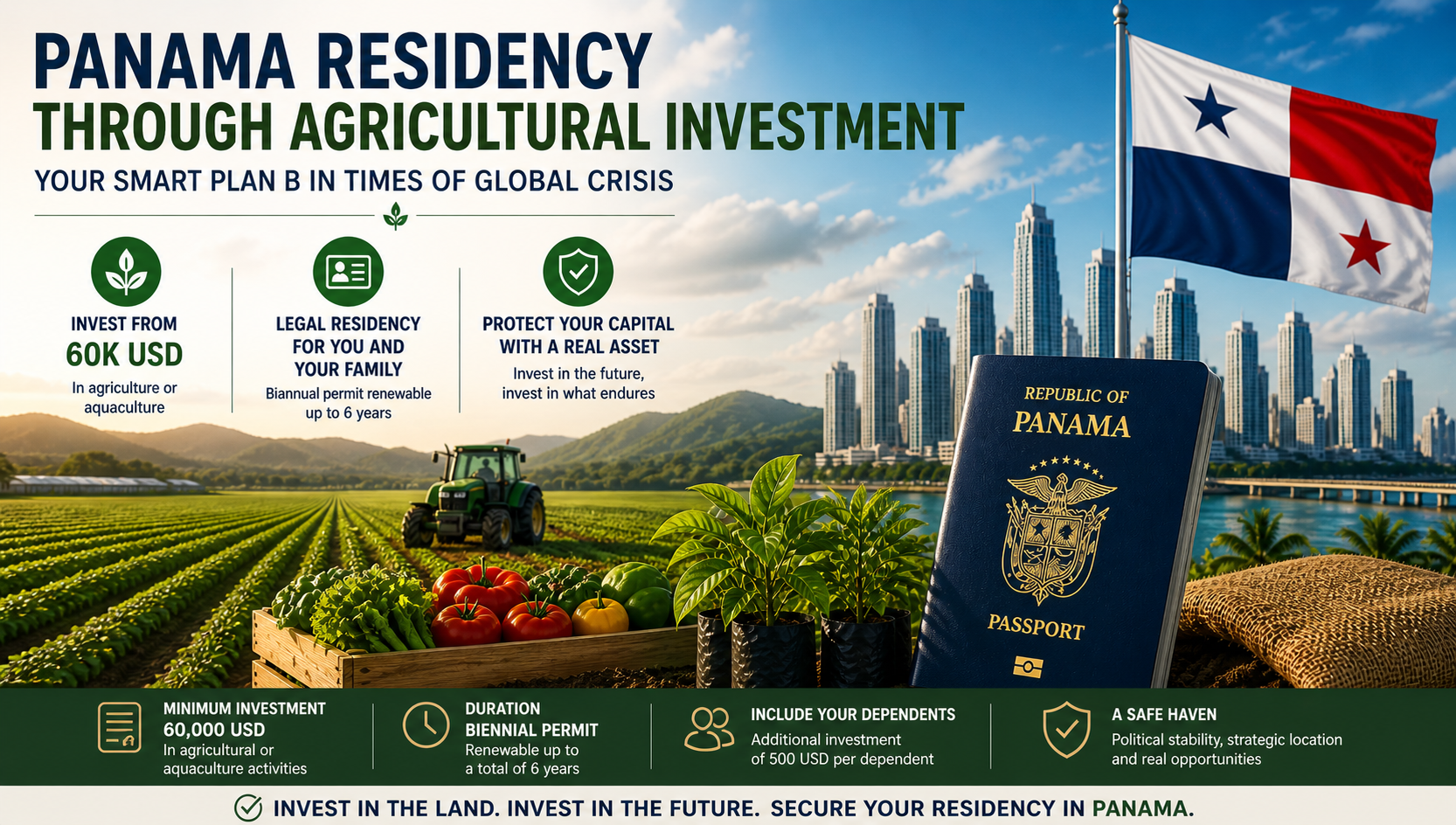
The basic requirement for this permit is a minimum investment of 60,000 USD in agricultural or aquaculture activities. This amount positions residency in Panama through agricultural investment as an accessible option compared to other international programs that require much higher capital. This opens the door to small and medium investors who want to build a sustainable project without the need for large financial structures.
To understand the true potential of this option, it is necessary to analyze Panama’s agricultural environment. Although the sector represents approximately 3% of GDP, its impact is much broader in social and territorial terms. Thousands of jobs depend directly on this activity, especially in rural areas where foreign investment can generate a significant transformation.
The country has a varied and well-distributed agricultural production. Among the main products are sugar cane, rice, bananas, coffee, pineapple, melon, and watermelon. This diversity allows residency in Panama through agricultural investment not to be limited to a single production model, but to offer multiple alternatives depending on the investor’s profile and business objectives.
Residency in Panama through agricultural investment as a global Plan B
Rice, for example, is one of the pillars of domestic consumption and has a strong presence in provinces such as Chiriquí and Veraguas. This makes it a stable option for those seeking a consolidated local market. In contrast, crops such as melon and watermelon are more oriented toward export, especially to European markets, where the quality of Panamanian products has gained recognition.
Tropical fruits represent another segment with high potential. Papaya, mango, orange, and pineapple have significant production in regions such as Coclé, Herrera, and Darién. These conditions make residency in Panama through agricultural investment particularly attractive for those seeking to invest in crops with high international demand and relatively fast production cycles.
In addition, there are high-value products such as coffee and cocoa. Panama has positioned itself in the international market with premium coffee varieties that reach high prices in specialized auctions. These opportunities elevate the level of residency in Panama through agricultural investment, allowing access to niche markets where quality prevails over quantity.
Global population growth is another key factor driving agricultural investment. It is estimated that in the coming decades the demand for food will increase steadily, which forces expansion of production and improvement of efficiency. In this scenario, investing in agriculture is not a passing trend, but a structural necessity in countries with adequate natural conditions. Panama has a tropical climate, mineral-rich soils, and access to water resources, which allows cultivation throughout much of the year. These characteristics turn residency in Panama through agricultural investment into an option with clear competitive advantages over other markets.
Residency in Panama through agricultural investment: strategic investment 2026
Another relevant aspect is the cost of initial investment. Unlike countries where agricultural land has reached high prices, Panama still offers opportunities at competitive values. This allows residency in Panama through agricultural investment not only to generate income through production, but also through the progressive appreciation of the land.
In addition, the country has a privileged logistical position. Its location facilitates export to the United States, Europe, and other Latin American markets. This advantage reduces transport time and costs, improving the profitability of agricultural projects developed under the residency in Panama through agricultural investment model.
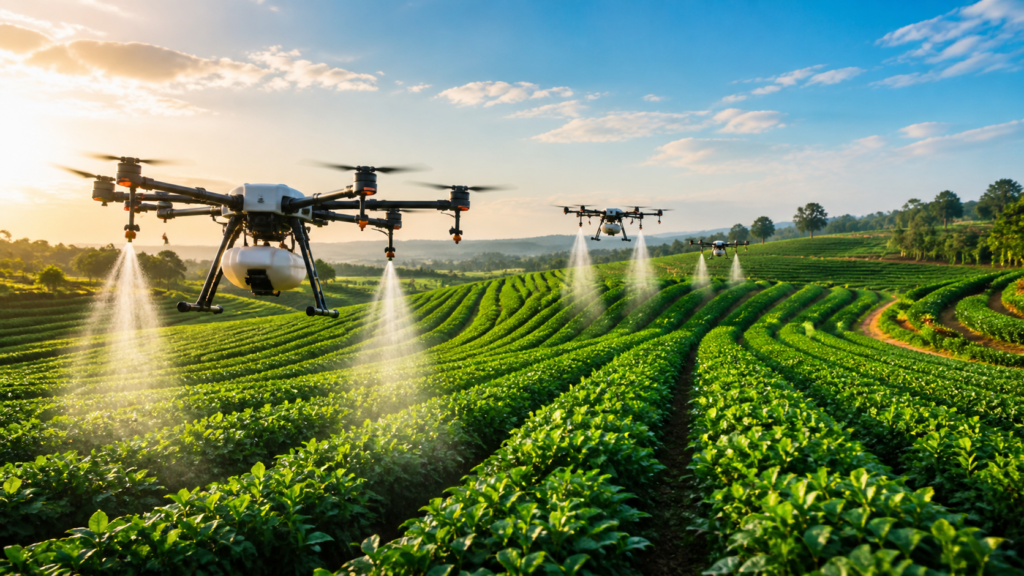
The sector is also evolving technologically. More and more producers are incorporating tools such as drip irrigation, moisture sensors, biostimulants, and nutrient optimization techniques. These innovations increase productivity and reduce operating costs, making the investment more efficient.
At the same time, interest in sustainable agriculture is growing. Organic and ecological models are gaining ground, driven by international demand for chemical-free products. In regions such as Chiriquí, this type of production is already part of the agricultural strategy, adding value to residency in Panama through agricultural investment.
However, not everything is positive. The sector faces important challenges. There is a technological gap compared to more developed countries, which limits productivity in some cases. In addition, climate change introduces uncertainty into agricultural cycles, affecting production stability.
For this reason, residency in Panama through agricultural investment requires strategic planning. It is not enough to invest capital. It is necessary to analyze the type of crop, land conditions, access to water, and market trends. Proper project structuring is key to minimizing risks.
Residency in Panama through agricultural investment: refuge in crisis
It is also important to choose the appropriate production model. Intensive agriculture allows maximizing production through the use of technology and fertilizers, while extensive agriculture uses large areas with lower investment per hectare. Organic agriculture, for its part, prioritizes sustainability and environmental balance. Irrigation and rainfed systems also influence profitability. Irrigation allows greater control over production, while rainfed agriculture depends on rainfall. Each approach has advantages and limitations that must be evaluated before starting a project under residency in Panama through agricultural investment.
Agricultural activity is mainly concentrated in the interior of the country. Provinces such as Chiriquí, Coclé, Veraguas, and Herrera offer ideal conditions for different types of crops. These regions combine favorable climate, land availability, and access to natural resources. Institutional support also plays an important role. The Ministry of Agricultural Development promotes support programs, technical assistance, and agricultural fairs. In addition, IDIAP develops research aimed at improving productivity and sustainability in the sector.
Another point to consider is diversification. Crops such as mango, avocado, and citrus have shown sustained growth in international demand. Avocado, for example, has experienced a significant increase in global consumption, making it an interesting option within residency in Panama through agricultural investment.
In financial terms, some well-structured agricultural investments can generate attractive long-term returns. Although these are not immediate returns, the combination of production, export, and land appreciation creates a solid and sustainable model. Residency in Panama through agricultural investment also offers tax advantages. The country’s territorial system allows income generated outside Panama not to be subject to local taxes. This is especially attractive for investors with international operations.
The forgotten asset that gains value in times of global crisis
Despite its benefits, it is essential to understand that this type of investment requires an entrepreneurial mindset. Managing a farm involves planning, cost control, production supervision, and constant adaptation to market conditions. It is not a passive or automatic investment. However, precisely this characteristic is what gives it strength. Unlike speculative models, residency in Panama through agricultural investment is based on the creation of real value.
Ultimately, this option goes far beyond a migration permit. It represents an opportunity to integrate into a sector with growing demand, take advantage of a market that is still developing, and build a productive asset with long-term potential. For small investors, residency in Panama through agricultural investment is a gateway to a tangible business model, aligned with global trends and supported by favorable natural conditions. Those who understand this logic will not see simply a visa, but a strategy for sustainable growth in one of the most essential sectors of the global economy.
The current international context shows clear signs of fragility in supply systems. Conflicts such as the war in Ukraine have disrupted the global supply of grains and fertilizers, while trade tensions between powers such as the United States and China generate constant uncertainty in agricultural markets. Added to this is volatility in logistics costs, blockages in strategic routes, and restrictions on food exports by several countries. In this scenario, depending on external supply chains becomes increasingly risky. For this reason, residency in Panama through agricultural investment ceases to be just a migration option and becomes a strategic response to a potential partial collapse of global food trade.
Il business che potrebbe salvare il tuo patrimonio nella prossima crisi
Il panorama climatico non offre nemmeno stabilità. Eventi estremi associati al cambiamento climatico stanno colpendo i raccolti in molte regioni del mondo, con siccità prolungate, inondazioni impreviste e cambiamenti nei cicli produttivi. Questo ha già provocato aumenti nei prezzi degli alimenti di base e mette ulteriormente sotto pressione i sistemi agricoli tradizionali. In un contesto in cui la produzione globale affronta limitazioni crescenti, controllare una fonte propria di alimenti e produzione diventa un vantaggio critico. La residenza a Panama per investimento agricolo consente di anticipare questo scenario, posizionando l’investitore non solo come partecipante al mercato, ma come produttore in un ambiente che potrebbe diventare sempre più restrittivo e competitivo.
Per completare l’analisi, è fondamentale comprendere che la residenza a Panama per investimento agricolo non si basa solo su un’opportunità economica, ma su un quadro legale chiaro che richiede il rispetto rigoroso dei requisiti. Questo permesso, noto come PRT-AI, è progettato per stranieri che investono in modo diretto in attività agropecuarie o acquicole con un minimo di 60.000 balboas. Tali attività devono essere allineate ai settori definiti dal Ministero dello Sviluppo Agropecuario come di interesse nazionale, il che garantisce coerenza con la politica produttiva del Paese.
In termini pratici, la residenza a Panama per investimento agricolo richiede la presentazione di una procura e domanda debitamente notarizzata con i relativi bolli fiscali, insieme a tre fotografie recenti e copia autenticata del passaporto. Si richiede inoltre un certificato dei precedenti penali. Inoltre, è necessario un certificato medico che attesti la condizione del richiedente. A ciò si aggiungono i pagamenti obbligatori mediante assegno certificato, inclusi 250 balboas al Tesoro Nazionale e 800 balboas al Servizio Nazionale di Migrazione. Il processo prosegue con la dichiarazione giurata dei precedenti personali e, soprattutto, con la certificazione di un contabile pubblico autorizzato che confermi sia l’importo investito sia l’origine del capitale.
Requisiti legali e costi reali per ottenere il permesso agricolo a Panama
La certificazione del CPA è critica, poiché la residenza a Panama per investimento agricolo richiede totale trasparenza nella provenienza dei fondi. Inoltre, è necessario presentare l’iscrizione al Registro Unico Agropecuario, dove vengono dettagliati l’attività, l’ubicazione della finca e la struttura operativa del progetto. Un altro requisito essenziale è dimostrare la titolarità o l’uso legale del terreno mediante certificazione del Registro Pubblico o contratto di locazione. La residenza a Panama per investimento agricolo richiede anche prove chiare dell’investimento realizzato, incluse certificazioni bancarie, bilanci auditati, fatture commerciali e documenti di acquisto di materiali o attrezzature.
Questo insieme documentale conferma che l’investimento non è teorico, ma eseguito in modo diretto nel settore produttivo. Per quanto riguarda la struttura familiare, la residenza a Panama per investimento agricolo consente includere dipendenti, a condizione che l’investimento venga aumentato di 500 balboas per ciascuno. Questo importo aggiuntivo può essere giustificato tramite referenza bancaria locale, il che facilita l’integrazione del nucleo familiare nel processo migratorio senza richiedere strutture complesse.
Per quanto riguarda la durata, questo permesso viene concesso per periodi di due anni, rinnovabili fino a un massimo di sei. Per il rinnovo, è necessario presentare nuovamente la maggior parte dei requisiti iniziali, ad eccezione del certificato dei precedenti penali e dei pagamenti tramite assegni. Tuttavia, viene aggiunto un elemento chiave: il certificato di regolarità fiscale nazionale, che conferma il rispetto degli obblighi fiscali all’interno di Panama.
Dal punto di vista operativo, strutturare correttamente la residenza a Panama per investimento agricolo può fare la differenza tra un processo fluido e uno problematico. Per questo motivo, lavorare con uno studio legale specializzato risulta fondamentale. In questo contesto, Caporaso & Partners offre un servizio completo per circa 2.500 euro, includendo gestione, consulenza e accompagnamento durante l’intero processo. Investi oggi nel futuro di Panama!